Venice: Family Style (Part One)
Truman Capote once said that being in Venice was like “eating an entire box of
chocolate liqueurs at once.” His words capture the intoxicating spell the city is known for
casting on visitors. More than just a destination, Venice feels like a doorway into another
world - one where the past and present seamlessly intersect to dazzle your senses. It’s
the rhythmic slap of water against bustling vaporettos, the reflection of ancient palazzos
in quiet canals, the briny scent of the morning’s catch from the Rialto Market, and the
feel of timeworn stone calli beneath your feet.
In October, we travelled to Venice with our adult children to celebrate three milestone
birthdays. What unfolded was so much more than a birthday trip; it was a rare
opportunity to discover one of the world’s most beautiful destinations as a family –
laughing, eating, and savoring the richness of Venetian life.
In this post, I will begin to share the itinerary I created for our five-night stay in San
Marco. As I discuss in When They Still Say Yes, planning an adventure with your adult
children and their partners comes with a unique set of rewards and challenges,
requiring a thoughtful balance between family time and individual free time. But with
flexibility, humor, respectful boundaries - and more than one bathroom – the experience
can lead to a deepening of family bonds and a lifetime of shared memories.
The Arrival
After flying into Milan, we boarded a high-speed train for an easy two-hour journey into
Stazione di Santa Lucia, the city’s main terminal. Located directly on the Grand Canal,
you only need to walk a short distance from the station to find yourself immersed in the
flow (quite literally) of Venice. Depending on the location of your accommodations, you
can either walk or take one of several water transport options to your desired location.
After twelve hours of travel, we opted for a private water taxi as a fast and direct way to
get to our Airbnb in San Marco, but there are much cheaper public vaporettos that run
regularly and make multiple stops.
Sailing along the Grand Canal into the heart of Venice feels amazingly cinematic, with a
rush of wind on your face as the city’s timeless beauty comes into view. We chose an
Airbnb located in San Marco, one of the smallest neighborhoods in Venice and home to
its iconic sites. It’s the most touristic of the city’s six districts or sestieri and that comes
with crowds and higher prices, but the central location makes it an ideal launch pad for
first time visitors.
Located in the quiet Campo Manin but just steps away from St. Mark’s Square, the
Palazzetto Manin encompasses the second floor of a beautifully restored 16 th -century
Venetian palazzo. With four spacious bedrooms and comfortable common areas, we
would be able to enjoy time together while still having plenty of private breathing space.
For a large group, this is a wonderful and affordable option to consider.
That evening, we kicked off our celebration with our first family activity. A relaxing
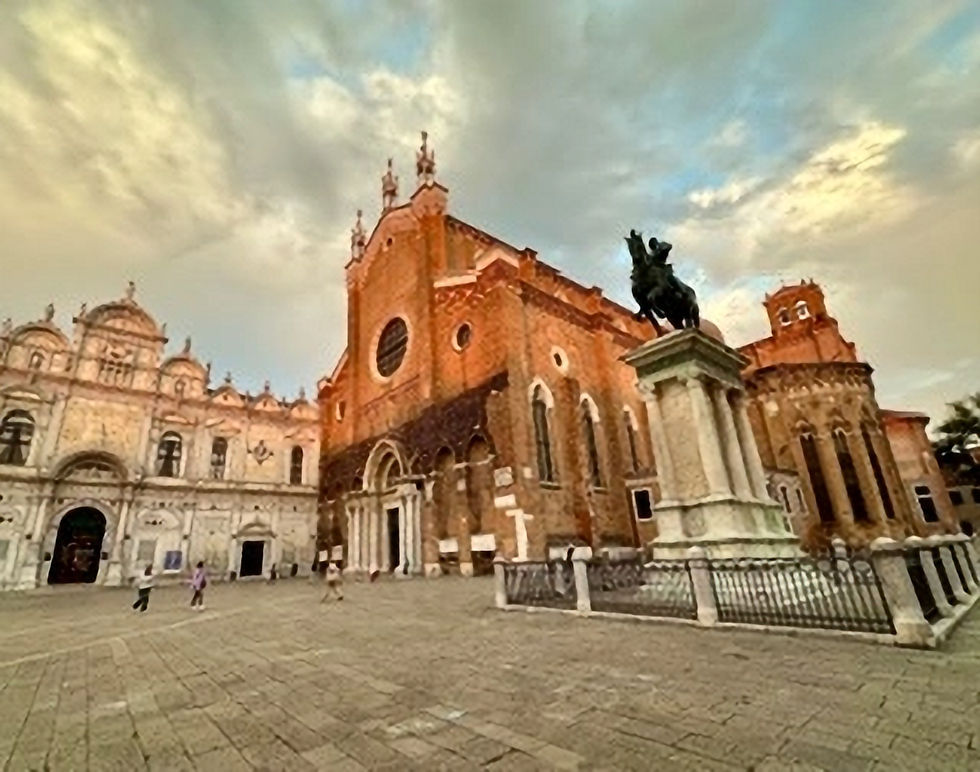
sunset stroll to the Campo Santi Giovanni e Paolo led us to the magnificent Basilica
by the same name. Completed in 1430, it is the largest church in Venice and the resting
place of twenty-five Venetian doges. With intricate marble altars, vibrant frescoes, and a
sprawling Italian gothic nave, the basilica is breathtaking – but that evening it was only
our meeting point. As we took in the stunning facade and vowed to return later in the
week for a visit, our guide Nino arrived to take us on a private Bacaro Tour. A bacaro is
a simple Venetian wine bar where locals gather to order wine and small plates called
cicchetti. They’re a staple of Venetian social life and a fun and inexpensive way to
sample a variety of traditional dishes and regional wines.
As a native Venetian, Nino guided us to four of his favorite family-run bacari in quiet
residential neighborhoods. They were packed with locals who spilled into the streets,
using barrels as tables as they warmly greeted each other. It was intimate, unhurried,
and delicious. As we ate and drank together, Nino shared personal stories about his life
and his city, prompting questions from all of us that he answered with insightful honesty.
I could see our children considering what they were learning and integrating it into their
worldview. For me, that was the moment the trip started.
As lovely as it is to visit historic sites and discover local cuisines, nothing is more
important than reaching out to real people to hear their perspectives – even (or most
especially) if they run counter to your own beliefs. The bacaro tour was great; our
conversation with Nino was better. Through these exchanges we break down
stereotypes, foster curiosity, and remind ourselves that people everywhere share similar
hopes and challenges.
As Americans, we’re conditioned in many ways to view our culture as “exceptional” and
this mindset often prevents us from acknowledging so many positive aspects of (in this
case) European life. Cleaner food systems, healthier work-life balances, more
egalitarian social services, a deeper appreciation for the arts, more realistic beauty
standards – all of these are traditional European values that I am continuously inspired
by when traveling.
After we said goodbye to Nino, we had a family discussion about the
differences between our cultures and our very patriotic son had a hard time admitting
that there is much that we can learn from Europe. Perhaps it is our mythologized history
that has led us to believe that questioning any of our cultural values is somehow
“unamerican.” It’s a very limited and limiting way to approach the world but one that can
be transformed by mindful travel. As a parent of adult children, it’s one of the few things
of lasting value that I can still help them discover.
Ultimately, travel is not about collecting places. It’s about learning how to openly listen,
think, and connect with respect and positivity – and then allowing yourself the freedom
to change your perspective. Sometimes that can begin with a barrel and a glass of wine.
Coming up: Venice: Family-Style (Part Two).
TIPS AND TAKES - Planning for your arrival in Venice
Travelers arriving at Venice Marco Polo Airport can reach the city by taking a bus (the
ACTV Line 5 or the ATVO Express) to Piazzale Roma or by using the Alilaguna
waterbus or a private water taxi that goes directly into the lagoon.
Those coming into Venezia Santa Lucia train station are already in the historic center
and can take a vaporetto/water taxi or cross the Calatrava Bridge on foot to reach
Piazzale Roma and other parts of the city.
Getting around by water transport:
1. Vaporettos – are public waterbuses that run fixed routes along the Grand Canal
and to major islands. They’re an inexpensive and efficient way to move around
the city for daily activities. Tickets can be purchased at individual stops at the
Venezia Unica ticket booths or from ticket machines. Multi-day passes are also
available.
2. Traghettos – are longer gondolas that are strictly used to ferry people across the
Grand Canal. They are strategically placed where bridges are not within easy
walking distance. They only cost a couple euros.
3. Water Taxis – are usually the fastest and most direct option to get to a specific
location. They are also the most expensive. You can hire one from many points
along the Grand Canal or you can arrange in advance to have one meet you at a
specific location for a door-to-experience. This option makes sense if you have
luggage that you don’t want to lug aboard a vaporetto or if you have a special
dinner planned at a restaurant that is not within easy walking distance. Be aware
that it can be difficult to get a water taxi during peak times of the day and plan
accordingly.
4. Gondolas – I hesitate to even list this iconic boat under transportation, as it
really is an experience entirely its own. They are expensive – and rates are
typically negotiated with a gondolier for a set amount of time. But – you’re in
Venice…bite the bullet and climb in.
Where to Stay:
Venice is divided into six historic neighborhoods called sestieri—each with a distinct
personality. Travelers typically choose between convenience to must-see sites (San
Marco and San Polo), local atmosphere (Cannaregio and Castello), artsy vibes
(Dorsoduro), or proximity to bus and train options (Santa Croce). Hotel prices tend to
increase the closer you get to San Marco. The good news is that Venice is a very
walkable city and, when combined with the water transportation options, you can easily
move between sestieri.
Streets in Venice are usually listed by their sestieri first, followed by a unique building
number, which can make finding a specific location challenging. Wandering the city’s
picturesque alleys (or calli) is an essential experience for any visitor – BUT, if you need
to get somewhere directly, Google Maps (or the like) is a must.
Cited here:
Palazzetto Manin in San Marco:
Bacaro Tour with a Venetian (small group hosted by Nino):
Recommended Bacari for a local experience:
Osteria al Ponte – Campiello Widmann gia Biri
Da Alberto – Calle Larga Giacinto Gallina
Ai Promessi Spasi – Calle dell’Oca
Antica Adelaide – Racheta, Calle Priuli
Enoteca Al Volto – Calle Cavalli, 4081
Bar All’arco – S. Polo, 436
Osteria Al Tappo – Cannaregio,1188
Al Merca – Campo Bella Vienna, 213
Un Mondo di Vino – Salizada S. Canzian, 5984/a




Comments